The Ground Beneath the Blueprint: Land Tenure Terms for Community Infrastructure in Madagascar
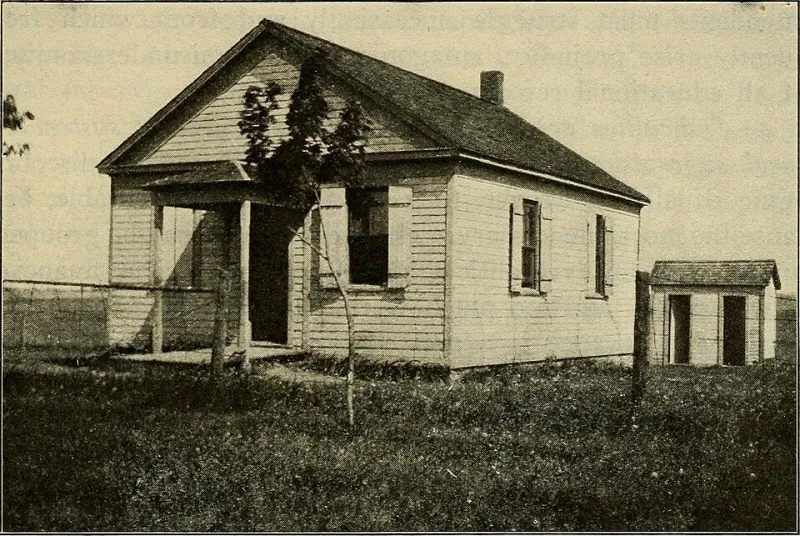
Photo: Internet Archive Book Images, No restrictions, via Wikimedia Commons
A school, clinic, or water point is never only a structure. It is also a claim on land. For U.S. funders working with Malagasy associations, the construction budget often arrives with detailed drawings and a schedule, while the land question arrives later, usually when a boundary is disputed or a family objects. The result is predictable: a foundation poured on ground whose tenure was never settled. The terms below are not a substitute for Malagasy legal advice. They are a way to make the land question explicit before it becomes a construction problem.
Begin With Use, Not Ownership
American grant agreements tend to ask who owns the land. In much of rural Madagascar, that question may not have a single answer. Land may be held through written title, through a land certificate issued at the commune level, or through customary arrangements that families and communities have observed for generations. A plot may be used for grazing during one season, for passage throughout the year, and for cultivation by a household that does not describe itself as the owner.
Before drafting a tenure clause, the U.S. partner and the Malagasy association should map use. Who grazes animals there? Who crosses it to reach a rice field or a well? Who has planted trees, and who expects to harvest them? Which family or lineage is understood to hold the land, even if no document says so? These questions belong in the project file, not only in a conversation under a tree. A written summary of use rights, prepared with the association and reviewed by local counsel, gives the funder a defensible record of what the community understands.
Two Permissions, Not One
A common mistake is to treat a single signature as consent. Community infrastructure usually requires at least two kinds of permission: permission from the landholder or customary authority, and permission from local government. In Madagascar, the commune and the fokontany are not decorative endorsements. They are part of how land use and public facilities are recognized locally.
The agreement should identify each signatory by name and role, describe the parcel with a sketch and clear boundaries, and state what the land may be used for. If the landholder is a family or lineage, the document should show how the signatory was authorized to speak for the group. Witness signatures matter, as does translation into Malagasy and, where appropriate, French. A U.S. funder may be tempted to accept an English-language letter of permission. That letter may be useful for the funder's file, but it is not the record the community will rely on. The local-language document is the one that should be read aloud and explained before signature.
The Reversion Clause
What happens if the clinic closes, the school is relocated, or the U.S. partner exits? Without a reversion clause, the answer may be improvised years later by people who were not part of the original agreement. The clause should state what happens to the land, the building, and any equipment if the project ends or the facility ceases to operate for its intended purpose.
There is no universal answer. In some cases, the land should revert to the original holder, with the building treated according to a separate agreement. In others, the community association may hold the improvement while the underlying land remains with the family. The clause should also address removal: if a structure is to be dismantled, who pays, who may salvage materials, and what condition the land must be left in. A reversion clause that ignores the building is only half a clause.
Maintenance Is a Tenure Term
Maintenance is often treated as a post-construction budget line. It is better understood as a tenure term. If the community has agreed to host a water point on family land, who repairs the pump? If a school roof leaks, who is responsible for the roof, and who is responsible for the land beneath it? The agreement should name the maintenance obligations of the association, the community, and any local government body, and it should identify a maintenance fund or in-kind contribution.
Community labor should not be treated as free by default. A maintenance plan that assumes unpaid work may fail when households face a poor harvest or a cyclone. A modest, transparent maintenance budget, agreed in advance, is more durable than a promise of goodwill.
When the Deed and the Community Map Disagree
Sometimes a title deed describes one boundary while the community map describes another. The U.S. funder should not assume the deed automatically wins, and should not assume the map is correct either. The right response is to pause construction and gather evidence: the deed, any land certificate, commune records, witness statements, and a walked boundary with the neighbors present.
Local counsel should advise on the proper forum for resolving the conflict. In some cases, the commune land office may be able to clarify records. In others, a formal survey or mediation may be needed. The funder's role is not to adjudicate Malagasy land law. It is to refuse to pour concrete over an unresolved dispute.
What a U.S. Template Cannot Do
U.S. deed, title insurance, and easement templates can be useful prompts, but they do not map cleanly onto Malagasy tenure. American assumptions about recorded ownership, surveyed parcels, and county-level title searches do not resolve customary claims or commune-level records. A funder that imports a U.S. template without local review may create a document that satisfies a board in Washington but means little in the commune where the school is built.
A better approach is to budget for tenure due diligence as a project cost. That may include local counsel, a translator, a surveyor, and time for community meetings. It may also include a short waiting period before construction, so that objections can be heard. These costs are small compared with the cost of a building that cannot be used, maintained, or defended because the land question was left open.
A Practical Checklist
Before construction, the U.S. partner and the Malagasy association should be able to answer in writing: who holds the land, who uses it, who has consented, what local government approvals exist, what happens if the facility closes, who maintains it, and how a boundary dispute will be handled. If any answer is missing, the agreement is not ready. The ground beneath the blueprint deserves the same scrutiny as the blueprint itself.